Designing Trust: An AI Coaching Product from Research to Prototype
At a global talent management and leadership development company (name withheld), leadership launched a series of parallel "AI incubator" initiatives exploring how AI could extend the company's existing coaching and learning products. I was the sole UX designer on one of these tracks: an AI-enabled coaching product for leaders navigating a role transition.
60% of managers receive no formal support during a leadership transition — exactly when they need it most. Research made one thing clear early: an AI coaching tool that feels like it's evaluating you, rather than supporting you, gets rejected before it gets a chance to help. How do we design an AI coach leaders will actually trust with something real?
My Role
Sole UX designer and researcher on this product track for its first sprint, within a larger cohort of simultaneous AI incubator projects across the design org. Alongside my own project, I coached other designers and product managers on incorporating AI tools into their own design workflows.
Process
- Synthesized findings across 16 internal UX studies and 30+ peer-reviewed academic sources on trust in AI, workplace motivation, adult learning theory, and leadership-transition research
- Ran a structured research readout for leadership, organized around what leaders currently do when no coach is available, what builds or destroys trust in an AI tool, and what conditions predict genuine engagement vs. surface compliance
- Translated each research finding directly into a design condition, then built 5 prototype directions to test those conditions: three product entry-point concepts, an admin configuration wizard, and a manager-facing dashboard
- Identified the top adoption risk before designing anything else: visibility settings are configured by HR admins, not by the coachee — meaning trust could be broken by a setup choice the end user never even sees
Key Decisions
Default every visibility setting to private
Options considered: Default-open visibility (faster manager buy-in) vs. default-private visibility (deliberate opt-in only).
Decision: Default all manager-visibility settings to off; make visibility a deliberate, informed opt-in labeled "Recommended" rather than a passive default.
Why: Across the research, users described the same fear in nearly identical language: "if this can reach my manager, I'll only say safe things." Data collected for development being repurposed for evaluation was the single most consistent trust-killer in both internal studies and peer-reviewed literature. Default privacy was the strongest available signal of genuine safety.
Give the AI a non-directive persona, not an advisory one
Options considered: An AI that summarizes and gives direct advice vs. an AI that reflects, reframes, and asks questions without prescribing an answer.
Decision: Built the AI's behavior around one rule — every response adds something new (a reframe, an observation, a question) and never just repeats back what the user said or tells them what to do.
Why: Research on AI trust was consistent: people disengage the moment an AI tool feels like it's directing them. Preserving the user's sense of control over their own thinking predicted sustained engagement more reliably than the perceived intelligence of the advice itself.
Make every AI interaction user-called, never system-surfaced
Options considered: Ambient/proactive AI that surfaces coaching prompts contextually vs. an AI the user has to actively open.
Decision: The AI coach is available on demand but never interrupts — the user always initiates.
Why: Internal usability testing found AI-surfaced interactions were universally disliked, while user-called interactions significantly outperformed them on trust and engagement. Being "helped" by AI you didn't ask for reads as surveillance, not support.
Built the leading concept as a structured, scaffolded program — not an ambient assistant
Options considered: Three entry-point concepts were prototyped in parallel — an always-available ambient assistant, a structured onboarding program with a defined journey, and a coaching moment triggered by feedback events.
Decision: The structured-program concept became the strongest candidate with stakeholders.
Why: It extended a multi-modal, incremental learning-path pattern I had designed earlier in an unrelated product area at the same company, so it built on a product pattern users already trusted rather than asking them to adopt an entirely new interaction paradigm.
The Design
Research readout
Problem solved: Made a 17-page synthesis of internal and academic research legible to leadership as concrete, testable design conditions rather than an abstract literature review.
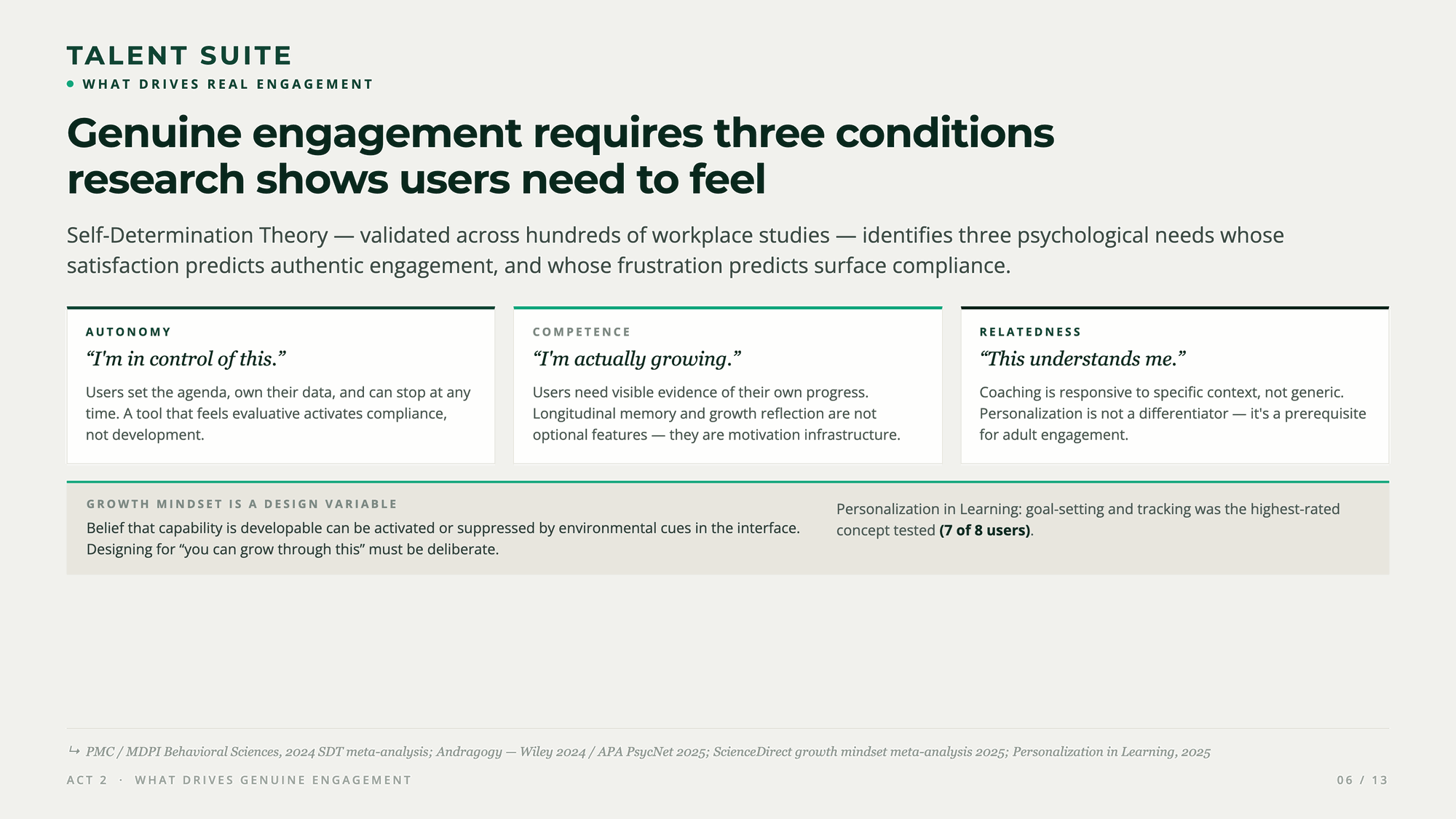
Self-Determination Theory, validated across hundreds of workplace studies, identifies three psychological needs whose satisfaction predicts authentic engagement and whose frustration predicts surface compliance: autonomy ("I'm in control of this"), competence ("I'm actually growing"), and relatedness ("this understands me"). Every prototype direction was measured against these three conditions.
Three entry-point concepts went into prototyping, each testing a different promise about what an AI coach is for. Same coachee, same organization, three different first contacts.
Concept 1 — AI Coach across the Talent Suite
Problem solved: Tests whether an always-available coach earns real use when nothing ever pushes a leader into it.
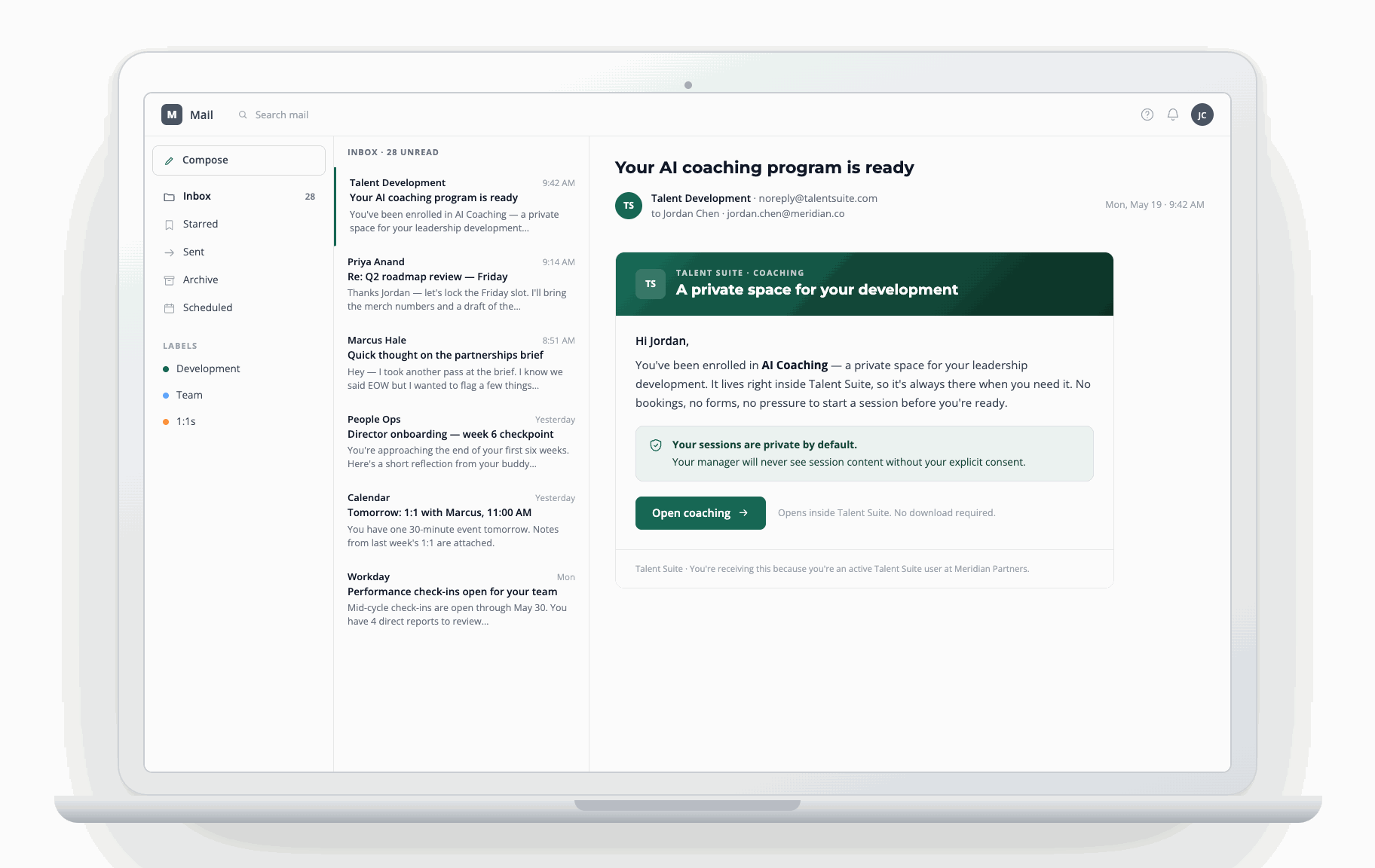
Enrollment arrives as ordinary mail. No program, no schedule: the coach is simply there when the coachee wants it.
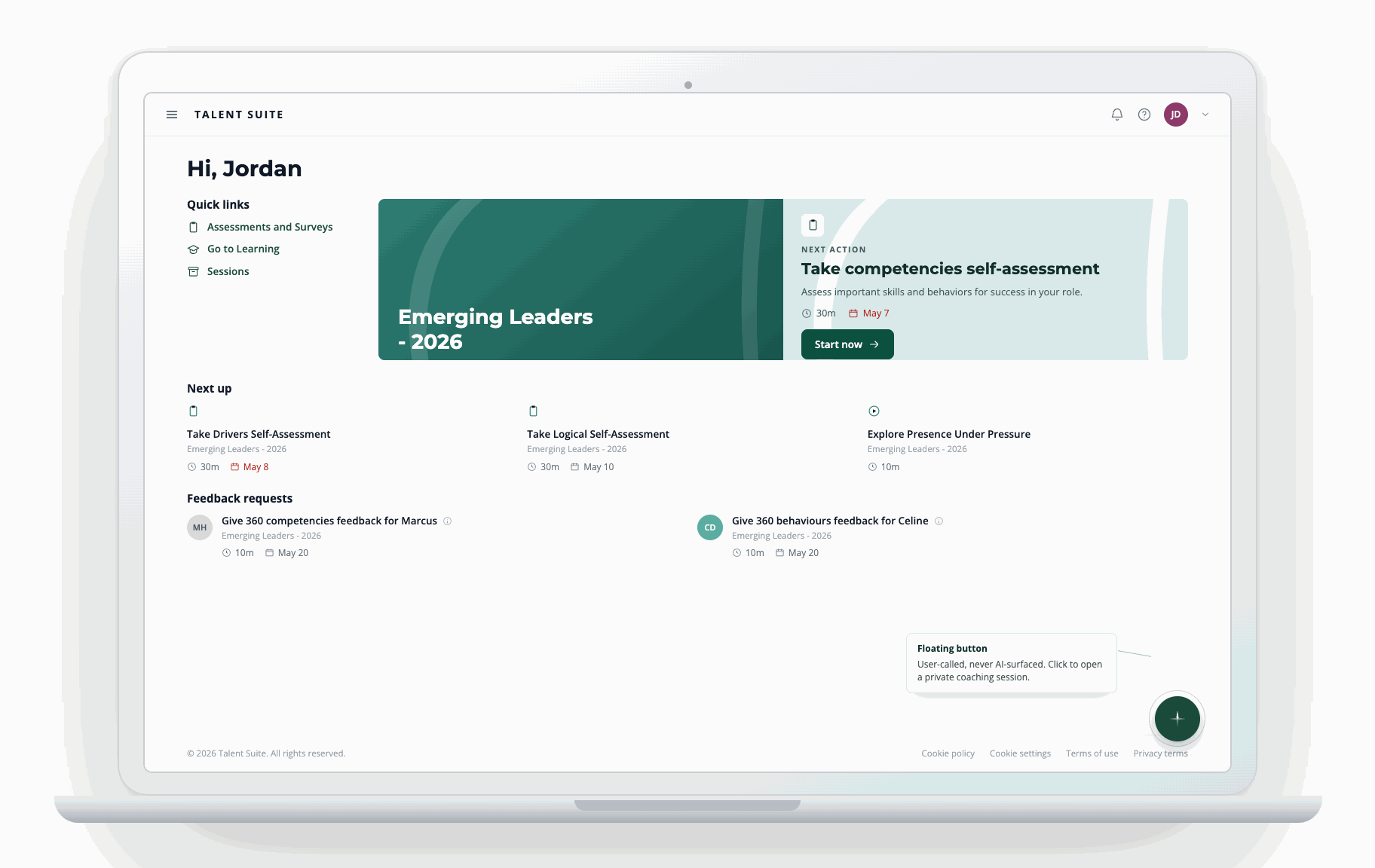
The coach sits in the corner of the normal dashboard — user-called and never AI-surfaced, so it's present everywhere without ever popping up uninvited.
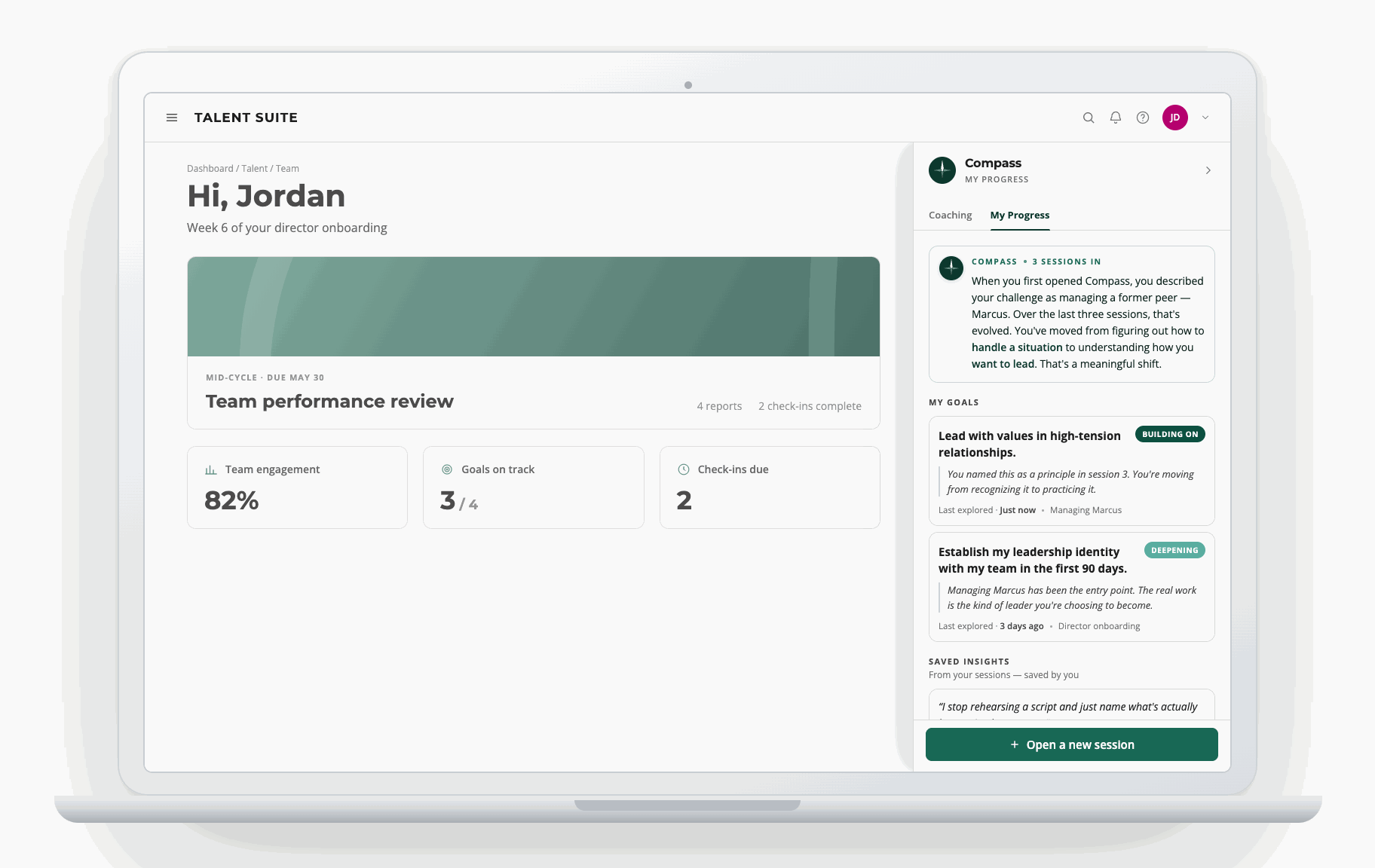
Compass narrates sessions back inside an overlay panel, then goals and saved insights in the coachee's own words — growth as a felt sense of accumulation, not a completion bar.
Concept 2 — AI Coach creates a program (the one that won)
Problem solved: Tests whether a structured six-month program can still feel personal rather than assigned — extending a multi-modal, incremental learning-path pattern already trusted elsewhere in the platform.
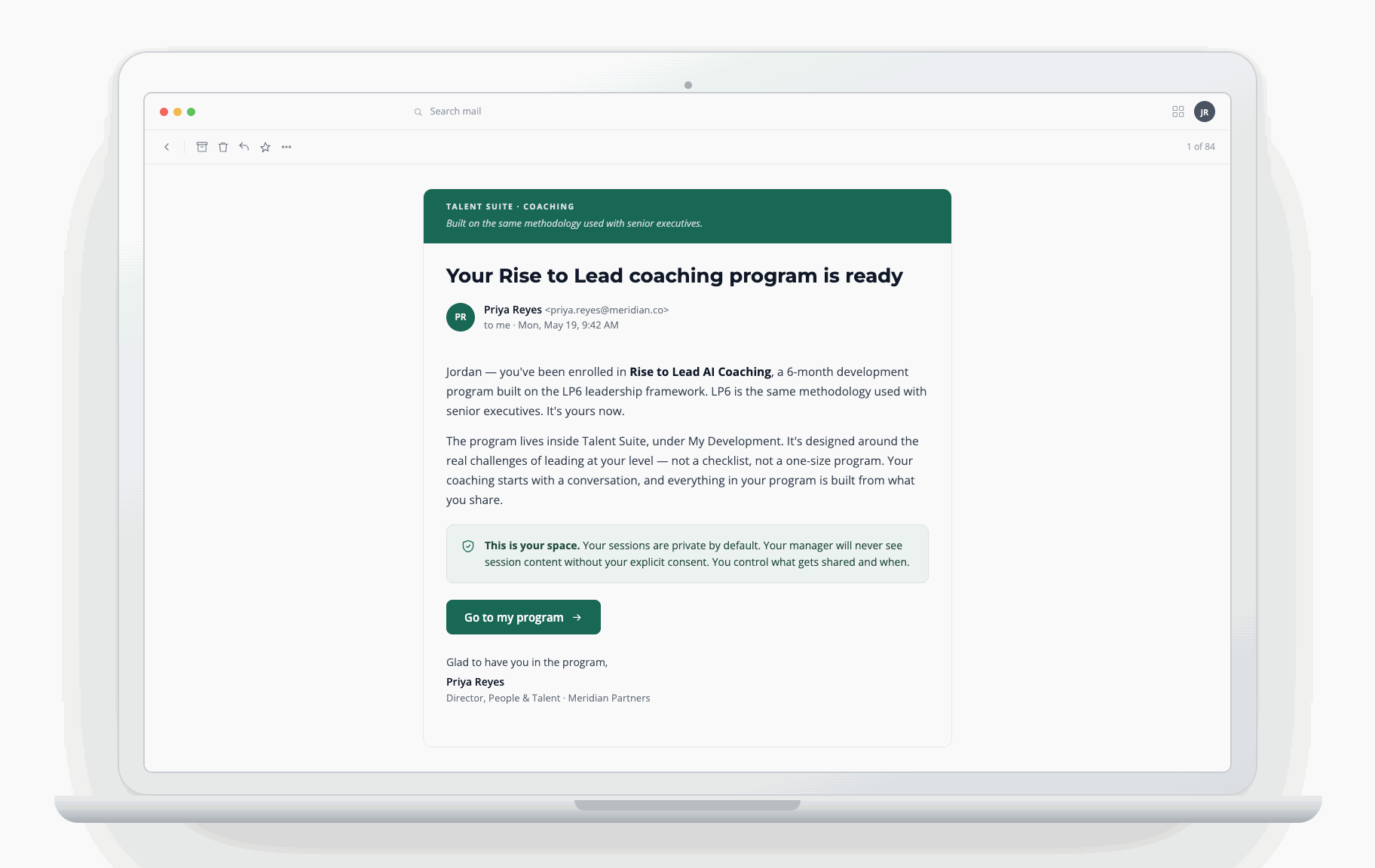
A named six-month program from a real person at the company, not a system notification.
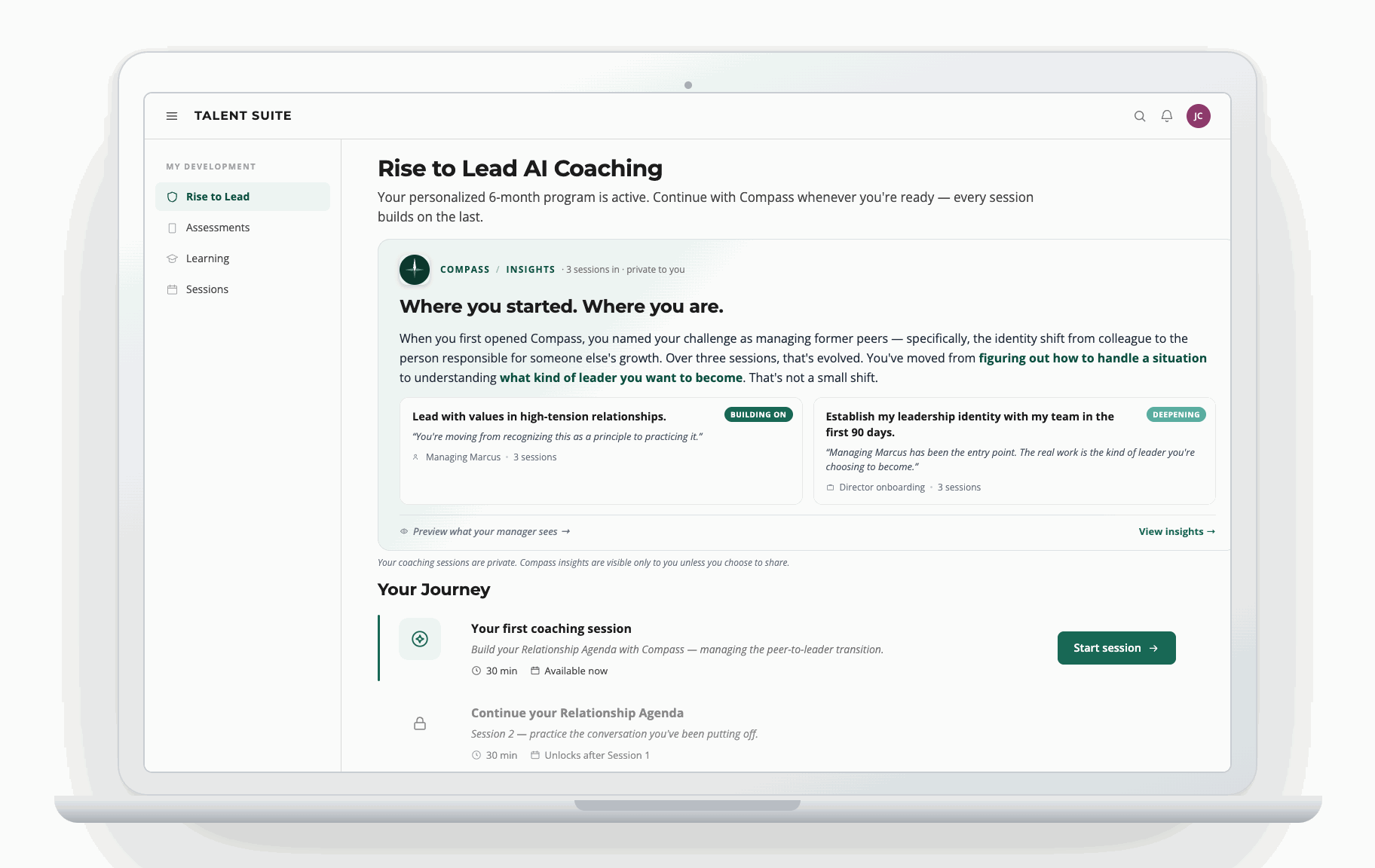
The hero card narrates how the coachee's framing of the problem has shifted across sessions — "where you started, where you are" — not a completion metric.
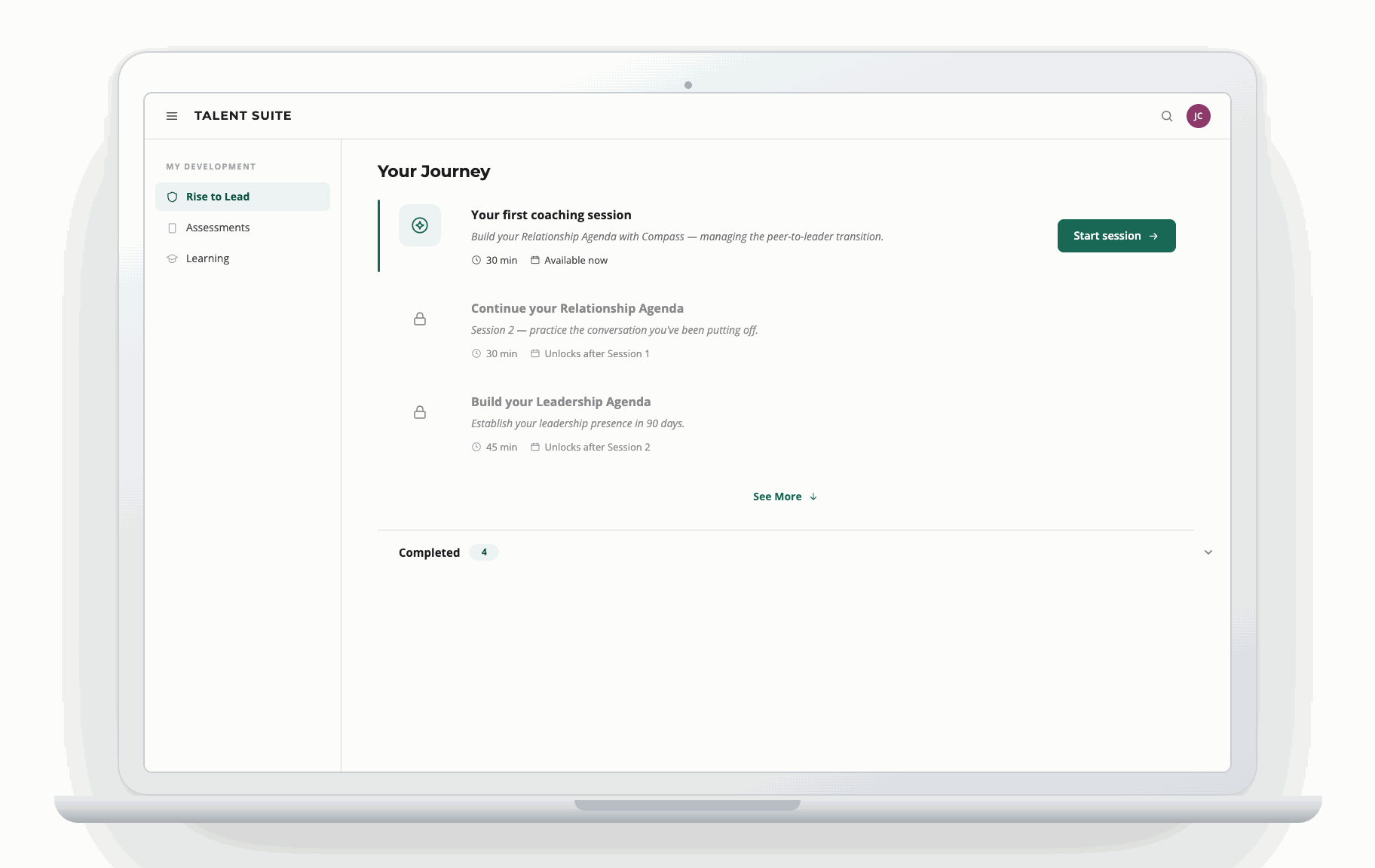
The next session is live; later ones stay locked, and completed work collapses into an accordion.
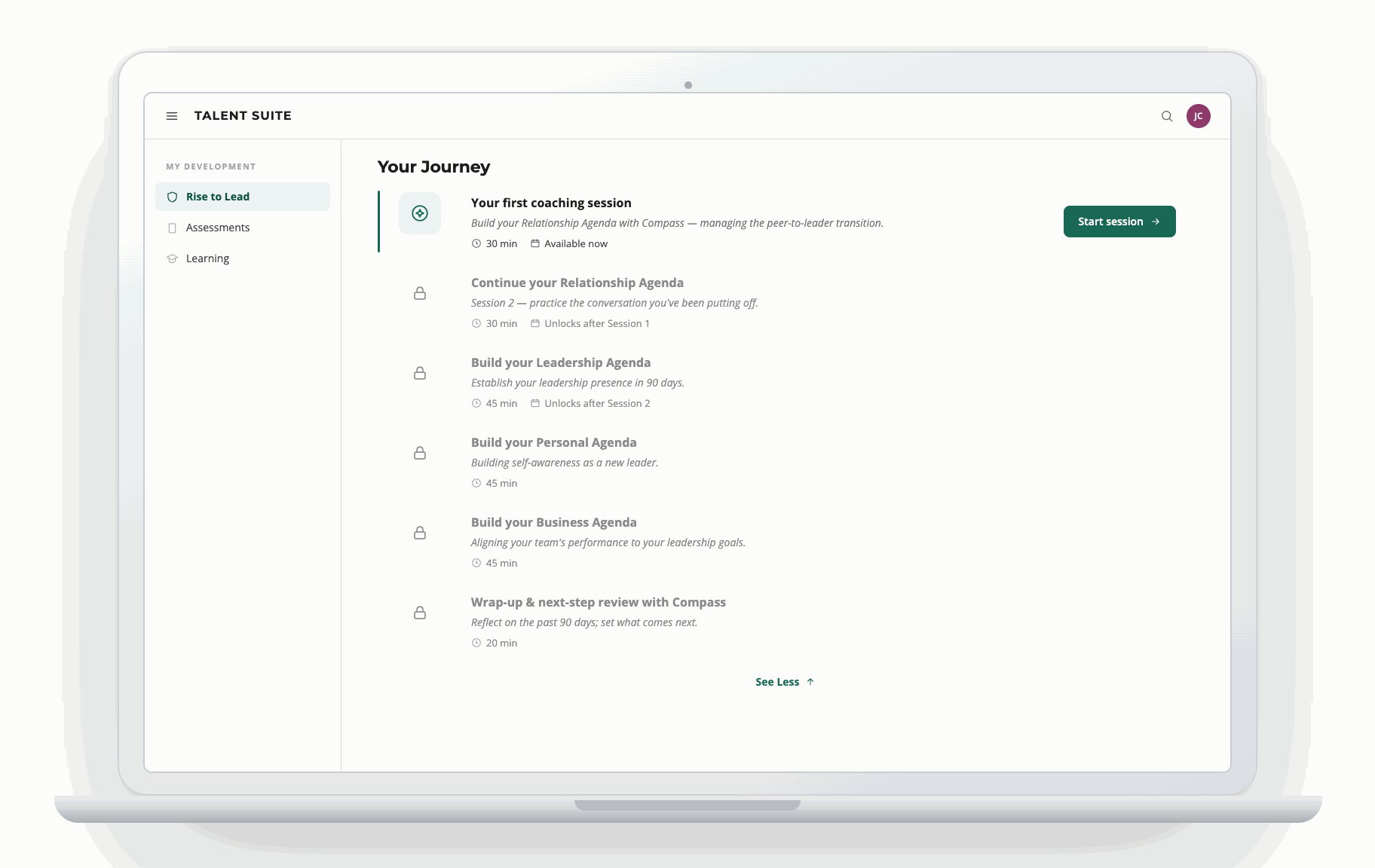
Expanded, the full arc of agenda-building sessions is visible — relationship, leadership, personal, business.
Concept 3 — AI Coach embedded in feedback
Problem solved: Coaching enters at the moment 360 results land — when the need for interpretation is highest — testing whether first contact works better in-product than as an email.
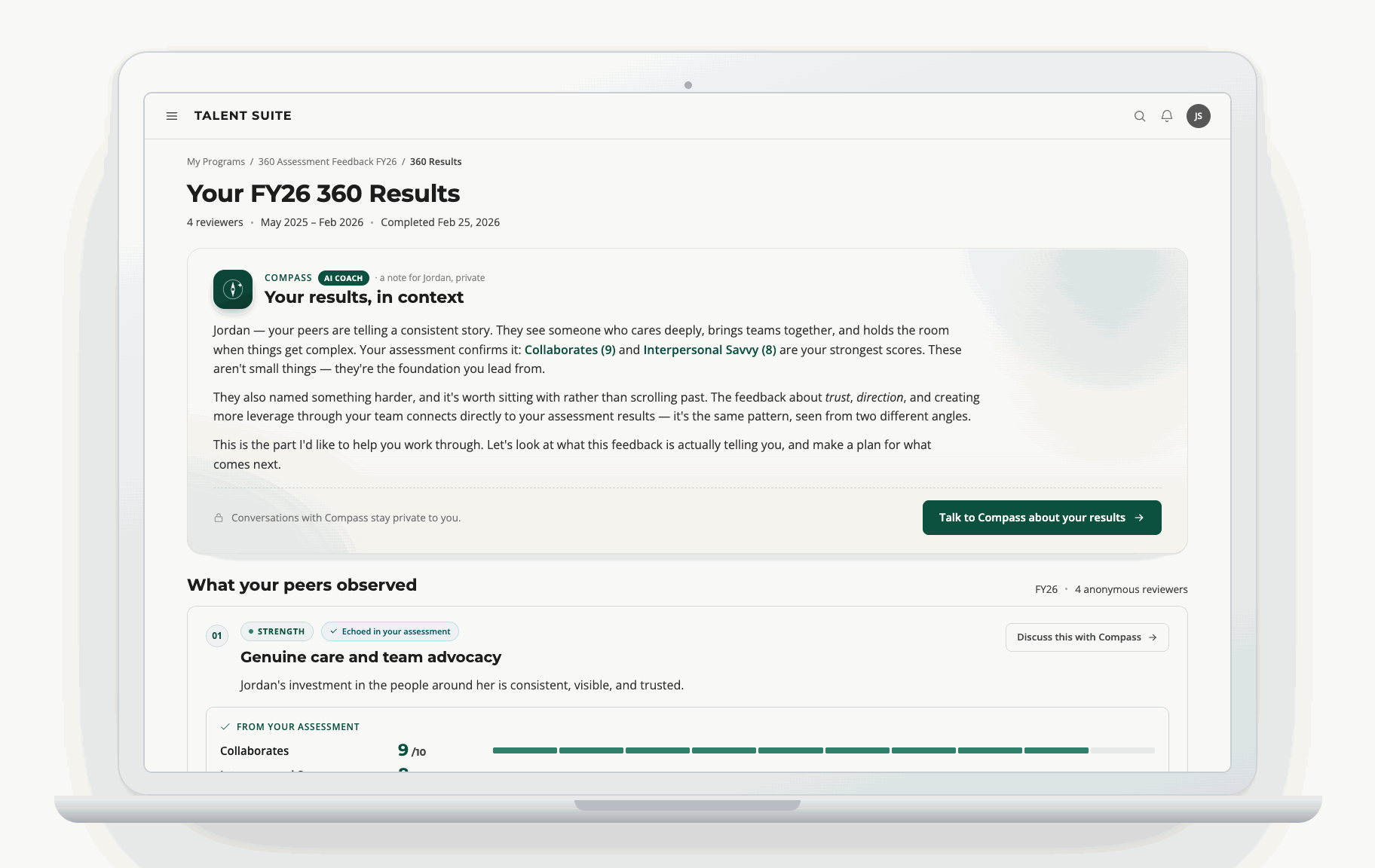
Compass reads the peer data as a narrative first; each theme then pairs a plain-language synthesis with the assessment scores behind it.
Admin configuration: teaching Compass an organization
Compass only works if it sounds like it belongs at the company using it — which meant designing a second surface entirely: a setup wizard where an org admin teaches Compass their culture, language, and boundaries before any employee ever opens it.
Configuration as coaching input, not app settings
Problem solved: Generic coaching language is the fastest way to lose a leader's trust. Rather than a typical settings panel, each setup question was framed as something Compass would visibly use in a real session — with a live "What Compass will now know" preview after every answer.
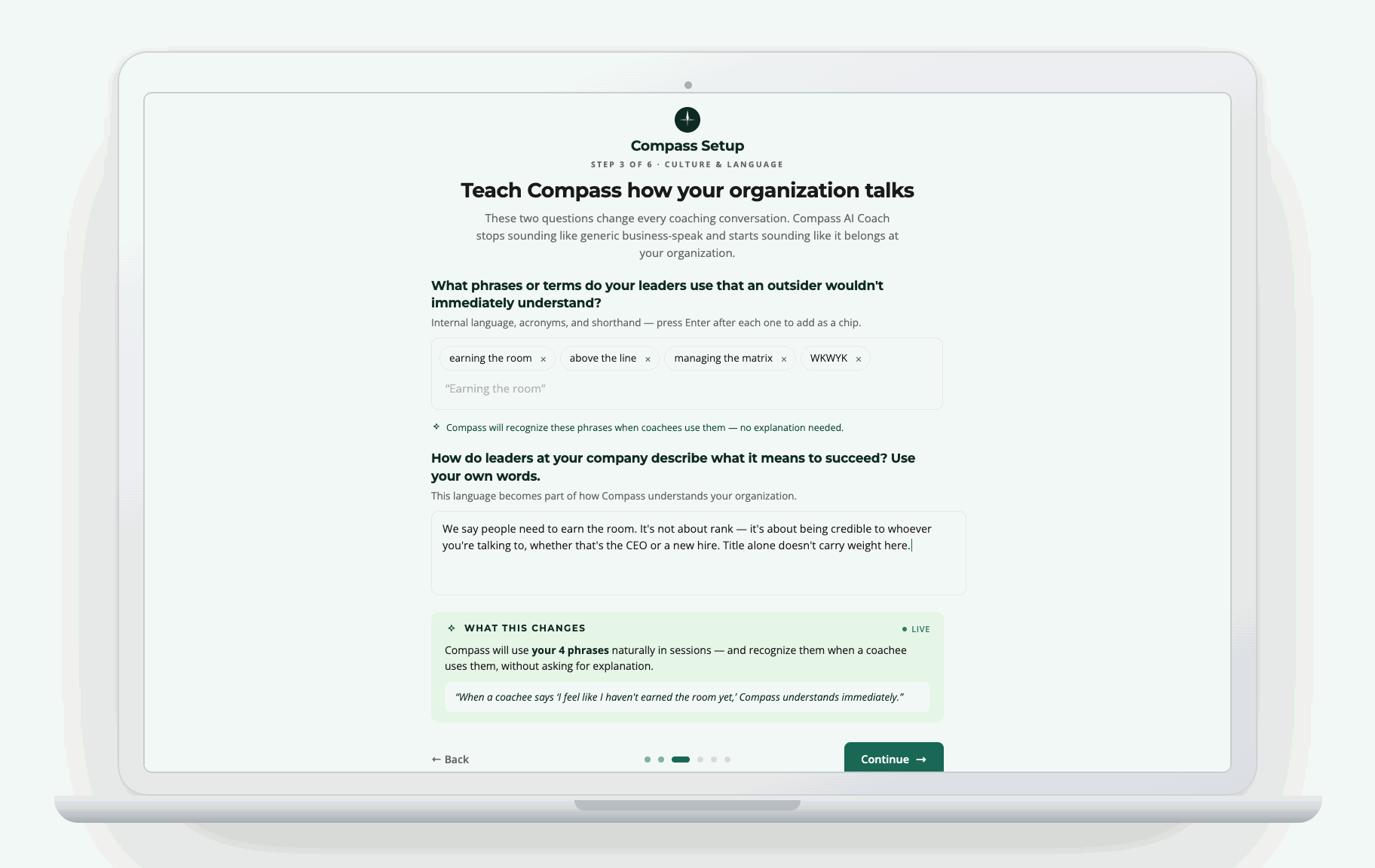
An admin's exact internal phrases — "earning the room," "above the line" — become words Compass recognizes and uses natively in sessions, instead of paraphrasing them into generic business-speak.
Trust architecture, configured explicitly
Problem solved: The same "private by default" principle from the coachee-facing product had to be enforced here too — as a deliberate admin decision, not a buried toggle, since this is the one screen that determines whether an entire organization's employees will trust the product at all.
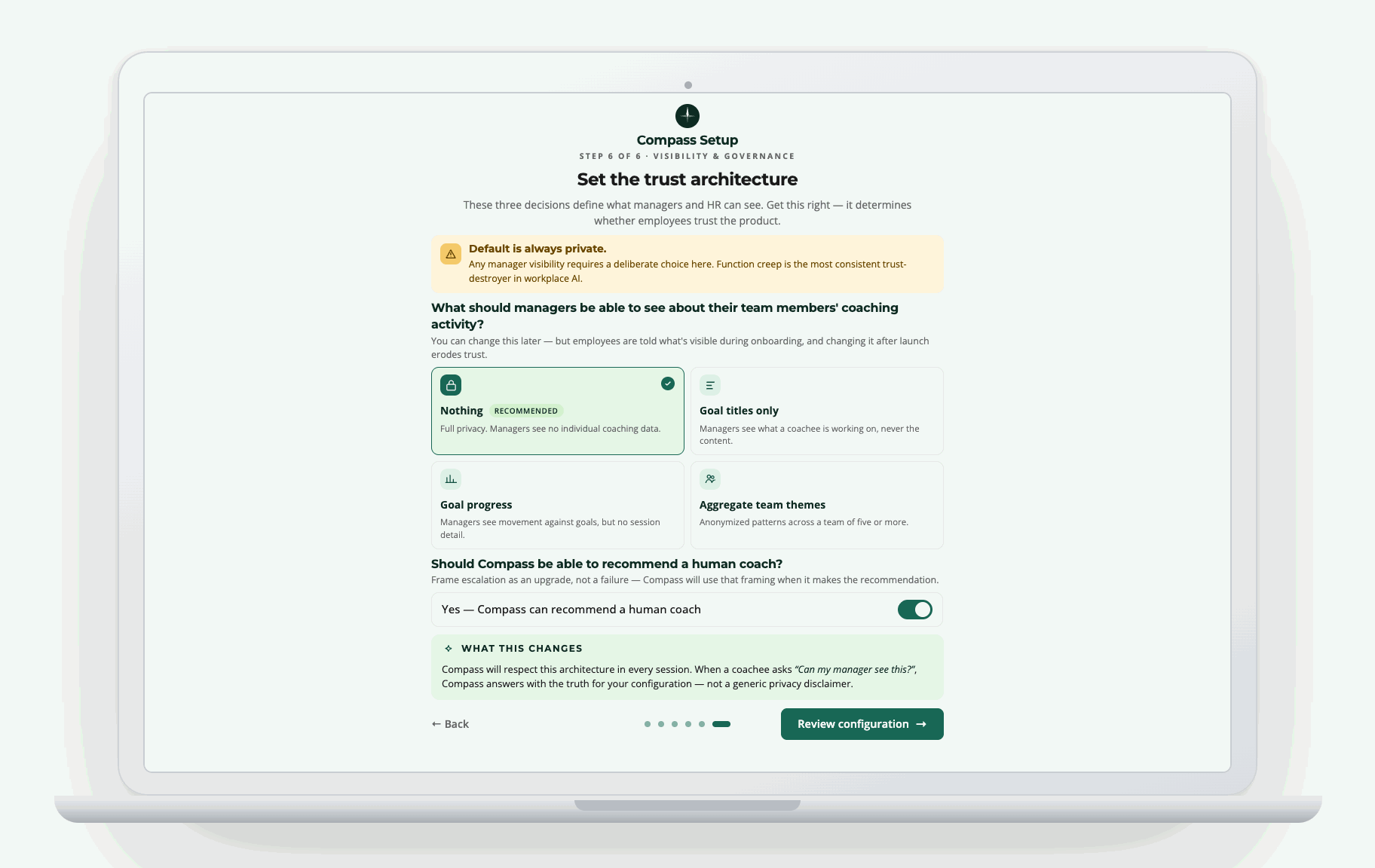
Privacy defaults to on, manager visibility defaults to "sees nothing," and the copy names the risk directly: "function creep is the most consistent trust-destroyer in workplace AI."
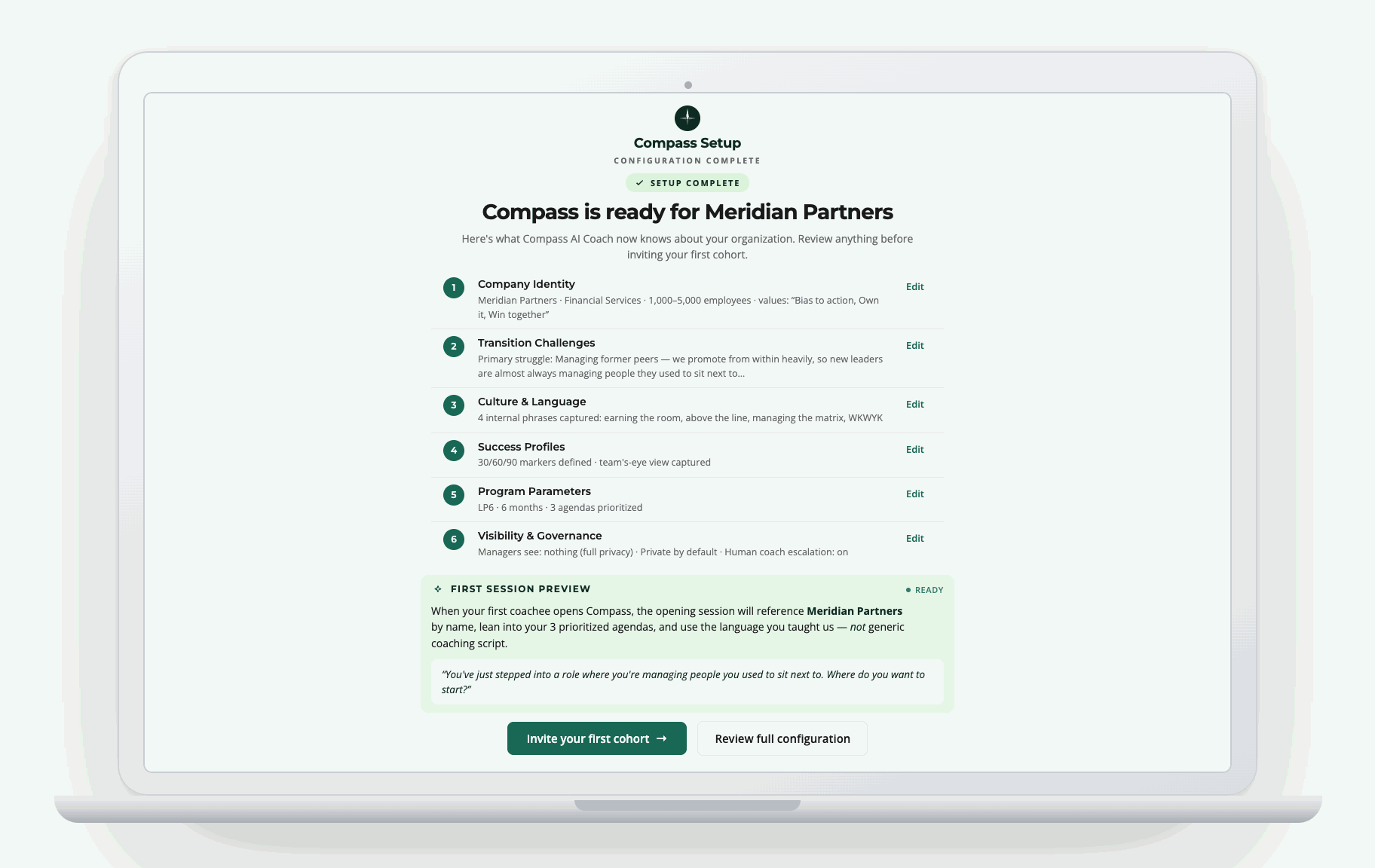
The six-step wizard closes with a plain-language recap and a "first session preview" — closing the loop between what an admin configures and what a coachee will actually experience.
Outcome
Reflection
This project is genuinely unfinished, and I'd rather say that plainly than paper over it. I didn't get to see the trust-architecture testing day through, or validate whether the retention hypothesis held. What I took from it: in AI product design, the deciding factor in adoption is almost never the AI's raw capability — it's whether the surrounding trust architecture (defaults, visibility, who's actually in control) earns someone's honest engagement. That's a lens I now bring to every AI-adjacent project.